Why Your Dog Keeps Licking Their Paws—and What Is Really Happening Beneath the Fur
The 3 a.m. scratching. The half-used shampoos. Another food change. If you recognize the cycle, understanding what can cause it is the first step toward a clearer daily routine.

Start here: persistent itching, sores, odor, hair loss or ear discomfort deserve veterinary advice. An itchy dog needs the cause investigated, not simply another product added to the shelf.[8]
You know the sound before you open your eyes.
A back paw thumping against the floor. A collar jingling. Then that soft, repetitive licking that somehow sounds much louder when the rest of the house is asleep.
You reach down. Say their name. Offer a little reassurance.
They stop for a moment.
Then they start again.
If that scene feels familiar, this article is for you. So is the bathroom shelf of half-used shampoos. The food bag you bought because someone said chicken might be the problem. The way you check their paws when they walk into the room, even when you are trying not to worry.
You are not looking for a more impressive supplement label. You are looking for your dog to be comfortable in their own skin.
And before you choose another product, you deserve a clearer explanation of why the itching may keep coming back.
Not a secret diagnosis. Not a story about every itchy dog having the same hidden problem. A practical look at what can set the process in motion, what can keep it going, and where a daily product such as Fets Allergy & Itch Soft Chews belongs.
Because once the pieces make sense, the next step can feel much less like another guess.
The Evening You Keep Having
Picture an ordinary evening. The walk is done. Dinner is over. Your dog has had their favorite spot on the couch for the last hour.
You should both be settling down.
Instead, you notice the same front paw in their mouth again. You gently move it away. They give you that innocent look, then return to the exact same place as soon as your hand leaves.
Perhaps you have started putting a blanket between their paws and the cushions. Perhaps there is a towel by the door because you wipe their feet after every walk. Perhaps you have become unusually familiar with the ingredients on pet shampoo bottles.
You are doing things. That is what makes it frustrating.
You have not ignored the problem. You have paid attention to it until you can hear a single scratch from another room.
Then comes the part that is harder to explain to someone whose dog does not do this. You begin measuring an evening by the interruptions. How long before the licking starts? Did they sleep through the movie? Was that a normal scratch, or the beginning of another restless night?
You miss being able to see your dog resting without checking whether they are actually comfortable.
There is a reason that feeling deserves to be taken seriously. Research on canine atopic dermatitis has found effects on the lives of both affected dogs and their owners. The problem can become part of the household routine, not simply a mark on a veterinary chart.[9]
It Is Easy to Blame Yourself. It Is More Useful to Understand the Pattern.
Maybe you wonder whether you chose the wrong food. Or did not rinse the shampoo properly. Or let them roll in the wrong patch of grass.
Maybe the advice has been so contradictory that you could assemble an entire care plan out of things people have told you to stop doing.
Stop feeding chicken. Stop feeding grains. Stop bathing so often. Bathe more often. Try this oil. Try that wipe. It must be yeast. It must be pollen. It must be boredom.
None of those comments can tell you what is happening in your particular dog.
A symptom can be familiar without its cause being obvious.
Itching is the experience you see expressed through scratching, biting, rubbing or licking. It is not a diagnosis by itself. Parasites, allergies and infections are among the possible causes a veterinarian investigates.[1]
That distinction changes the question.
Instead of asking, “Which product stops dogs scratching?” you can ask, “What is making my dog itch, and which part of the plan addresses that?”
It is a less dramatic question. It is also a much more useful one.
You can still want a simpler routine. You can still want a daily chew that is easy to give. Understanding the cause does not take those choices away. It gives you a better reason for making them.
And it gives you permission to stop treating every new suggestion as something you have somehow failed to try.
What Is Actually Happening Beneath the Fur?
Your dog's skin is more than the surface you can see when you part the fur. It is a living protective barrier, working alongside immune cells, nerves and microorganisms that normally inhabit the skin.
In canine atopic dermatitis, researchers describe changes involving barrier function, immune responses and the skin microbiome. These parts interact; the condition is not fully explained by one simple defect.[3]
Think of the barrier as the outside wall of a busy house. The wall has a job. So do the people watching the door, and the alarm that tells everyone when something needs attention.
That is an analogy, not a picture of a supplement repairing your dog's skin. But it helps explain why an itch can involve more than something resting on top of the coat.
An exposure in the environment, a sensitive immune response and the condition of the skin can all matter. A dog may be reacting to something you cannot see, even though the licking is very visible.
You can wash a paw and still need to investigate the reason that paw is uncomfortable. You can keep a home clean and still have a dog with allergic skin disease. You can love them very well and still need a different approach.
The fur hides the process. It does not make the discomfort less real.
This is why a useful explanation should help you understand the system without pretending that every itchy dog has the same broken piece.
The Signal That Makes Them Scratch
There is another part of the story you cannot see: the messages involved in the sensation of itch.
One of the molecules researchers have studied is interleukin-31, usually shortened to IL-31. In a canine study, administering canine IL-31 produced itching behaviors. The researchers also detected it in many dogs with naturally occurring atopic dermatitis.[4]
That does not mean IL-31 is the explanation for every scratch. It does show why allergic itch is more than a dog deciding to annoy you with a bad habit.
Imagine a notification that keeps arriving. You can put down the phone for a moment, but that does not necessarily stop the next message.
Now think about asking your dog to leave their paw alone. They may respond to your voice. They may look up, move closer, or briefly turn their attention elsewhere.
Then the feeling returns.
The behavior you want to stop may be their response to a sensation that has not stopped.
That is a reason to be curious rather than irritated. It is also a reason to involve your veterinarian rather than assume the answer is more distraction or a stronger command.
Fets is a dietary supplement, not an IL-31-targeting medication. The science of itch helps explain the problem; it does not turn a chew into a treatment for every pathway involved.
Why the Same Dog Can Seem Better, Then Worse Again
One good evening can make you feel as though you have finally found the answer.
The next bad evening can make you question everything you changed.
You look at the food bowl. The weather. The bedding. The walk you took. Was it the new treat? The grass? Did you forget something?
Sometimes there is a useful pattern. Sometimes you need more observations before you can see one.
Atopic dermatitis commonly involves recurring signs. Veterinary management may need to address exposures, itch, skin-barrier care and secondary infections together.[2]
That is different from a neat story in which a single purchase permanently removes the problem.
A better day is valuable. A pattern of better days is useful information. Neither should be turned into a diagnosis on its own.
Try to notice what you can actually describe. The number of times your dog wakes to lick. The area they return to. A change around their ears. Whether the skin looks different from last week.
Those observations are more useful than a general feeling that something is “a little better.” They also make it easier to explain what happened when you speak to your vet.
You do not need to become a researcher. You need a few reliable details that can travel with you into the next conversation.
Three Different Starting Points Can Look Surprisingly Similar
The dog scratching after a walk and the dog chewing their paws in the kitchen may look as though they have the same problem.
They may not.
Environmental allergy: pollen, dust mites and other environmental allergens can be relevant in atopic skin disease. A familiar home and an ordinary walk can still contain exposures your dog reacts to.[2]
Flea allergy: this involves sensitivity to components of flea saliva. Veterinary guidance addresses the pet, other household animals and the environment as appropriate; the issue is not solved by calling a home clean.[5]
Food allergy: an immune response to a food ingredient can cause skin signs. The route to investigating it is a veterinarian-directed elimination diet and assessment of the response, not simply choosing a different flavor every few days.[6]
There are other possibilities, including infections and other parasites. This list is a starting point for understanding, not a way to diagnose your dog from the couch.
Notice what all three have in common for you: they can leave you looking at a dog who cannot settle.
Notice what is different: the next useful action may depend on which cause is present.
That is why the same recommendation can help one owner's dog and leave another owner disappointed. Similar symptoms do not guarantee an identical problem—or an identical response.
“But We Have Already Changed Their Food.”
This may be the sentence you have said most often.
You chose the sensitive-skin bag. You moved from one protein to another. You checked the front of the package, then checked the ingredients on the back. You made the transition carefully because you did not want to upset their stomach.
And still, the licking continued.
A food change can be a thoughtful choice without being a diagnostic food trial. Those are different things.
A structured elimination diet has rules about what a dog eats, including treats, extras and flavored products. Reintroducing the previous food under veterinary guidance helps determine whether improvement was actually related to the diet.[6]
The little extras matter when the purpose is to get a clear answer.
That includes a new supplement. If your dog is on a diagnostic food trial, ask before introducing Fets or any other flavored chew. A product that fits an everyday routine may not fit that particular test.
This is not a reason to feel that your earlier food changes were foolish. You were trying to help with the information you had.
It is a reason to make the next change more deliberate. Tell your vet exactly what you have fed, including the treats that barely felt worth mentioning.
A clearer history can save you from repeating a different-looking version of the same experiment.
Why the Licking Can Become Its Own Complication
There is a difference between a dog touching an uncomfortable spot and a dog returning to it over and over.
Repeated rubbing, scratching and licking can accompany changes in the skin. Secondary bacterial or yeast infections may also contribute to itching, making the picture more complicated.[1]
This is one reason a familiar problem can start looking different. You were watching a paw. Now you are noticing odor, redness or a change around an ear as well.
It is tempting to give the latest visible sign a name yourself. There is plenty of confident advice online, and it often comes with a product link.
But a photograph is not the same as examining the skin. An odor is not a laboratory result.
Write down what changed and let your veterinarian decide what needs checking. The details you notice at home can be valuable precisely because you see your dog every day.
You know which spot they keep choosing. You know whether the licking interrupted sleep. You know whether this looks different from their usual pattern.
Use that knowledge as part of the investigation. You do not have to turn it into a diagnosis to make it useful.
And you do not have to wait for a supplement trial to finish before reporting a worsening symptom.
The Shelf of Things That Almost Helped
There may be a bottle you still keep because it seemed to help once.
A spray you do not like using near the furniture. A shampoo that made bath day feel like a project. An oil that your dog ate happily, even though you could not tell whether anything changed.
You bought them for a very simple reason: your dog was uncomfortable, and someone offered you a possibility.
That is understandable. It is also how a care routine can become complicated before it becomes clear.
A product can have a legitimate role without doing every job. Cleaning the coat, reducing a particular exposure, treating an infection and providing a dietary supplement are different decisions.
You do not need one product to make every other product wrong. You need to understand why you are using each one.
Write down what is currently in the routine. Include the occasional things, the “only when it gets bad” things and the products you forgot were supplements too.
Then ask what each is for. Which are prescribed? Which are helping you monitor a response? Which are there because you never quite knew when to stop?
A shorter list is not automatically a better plan. A list with clear reasons is a much better place to start.
What a Better Conversation With Your Vet Can Sound Like
You do not need perfect medical language to make the appointment more useful.
Start with something specific: “She wakes to lick that front paw.” Or, “It is worse after we return from the park.” Or, “The ears started bothering him after the skin had been quiet for a while.”
Bring the ingredient labels if food and supplements are part of the conversation. Mention products you stopped as well as products you are still giving.
Veterinary guidelines emphasize a detailed history, examination and appropriate skin testing as part of working through allergic skin disease. Treatment is individualized rather than selected from a single universal routine.[7]
Here are four practical questions worth having ready:
What have we ruled out? It helps to know what is already understood, rather than feeling that each appointment starts from the beginning.
What is this part of the plan meant to do? A clear purpose makes it easier to follow through and notice a response.
What should I watch at home? Agree on observations you can actually make.
When should we review it? Knowing the next decision point can be reassuring when improvement is not instant.
You are not being difficult by asking. You are the person who will put the plan into practice every day.
The Ingredient Story Deserves a Closer Look, Too
Once you understand that itch can involve several moving parts, a supplement label starts to look different.
A long list of ingredients is not proof that every part of the problem has been addressed. A study of a plant compound does not automatically tell you what a finished chew will do in your dog.
Still, ingredients are worth understanding. You should be able to look at what you are buying and have a sensible conversation about it.
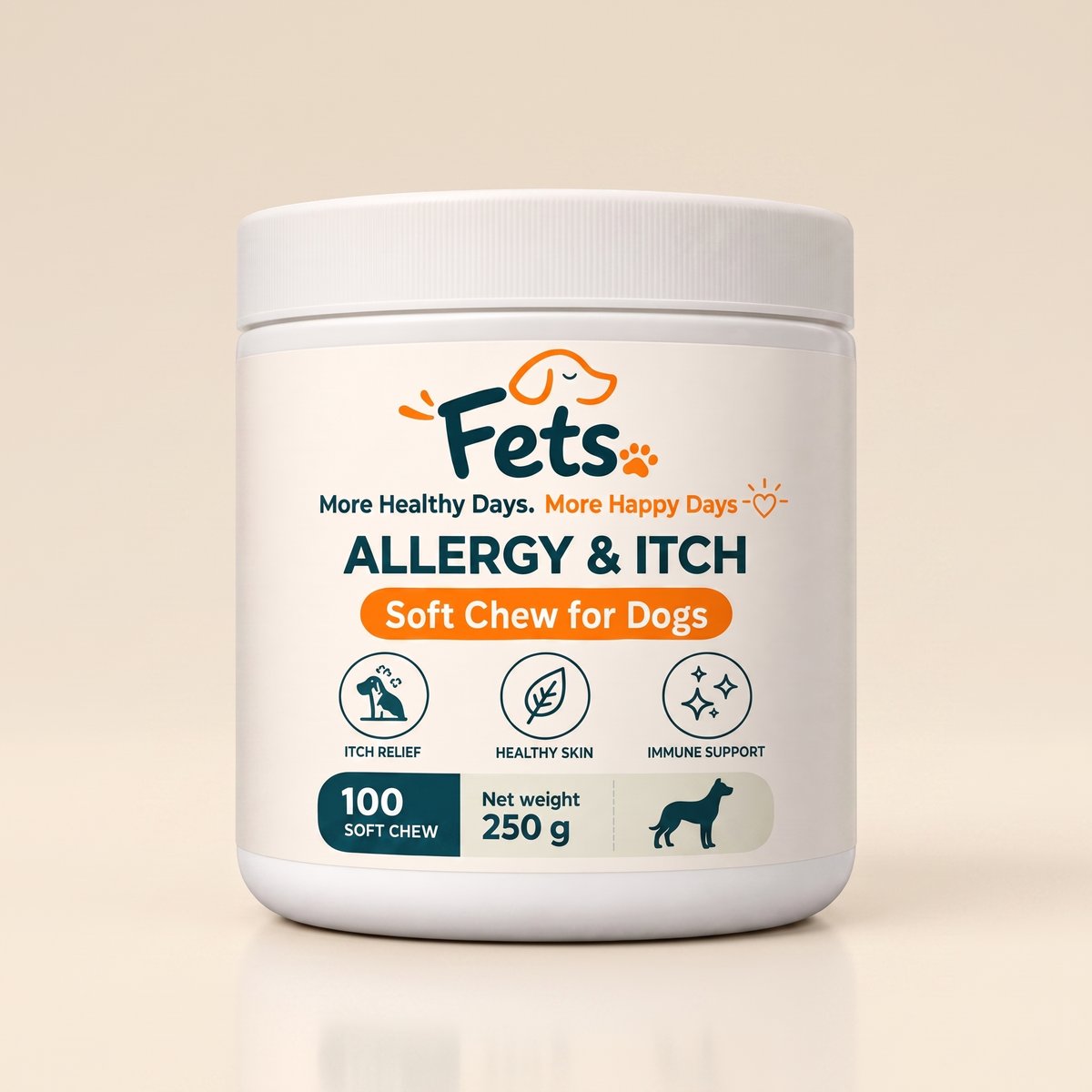
Fets Allergy & Itch Soft Chews combine nine listed active ingredients in a salmon-flavored format. The formula information includes omega-3 fatty acids, colostrum, astragalus, quercetin, turmeric, bromelain, black pepper extract, zinc and a multistrain probiotic blend.[13]
That is the starting point for transparency, not the end of the evidence question.
What is in the product? What is the current serving? Is the complete formula appropriate for your dog?
Those are good questions whether you are considering Fets or any other supplement.
The next section puts the ingredient names into plain language. It does not ask you to mistake the number of ingredients for a promise, or the promise on a label for a result your dog is guaranteed to experience.
Inside the Fets Formula
Omega-3 fatty acids. EPA and DHA are among the fatty acids studied in canine nutrition and dermatology. That makes the exact ingredient and amount worth checking, rather than treating “omega” as a magic word. Fets lists omega-3s among its active ingredients. Research on nutritional adjuncts does not establish that a particular finished chew will treat allergic skin disease.[10]
Colostrum. This milk-derived ingredient has been studied in canine nutrition. In one study of 24 adult dogs, a colostrum-supplemented diet affected measured immune responses and gut microbiota. That was dietary research, not a trial showing that Fets treats itchy skin.[16] It explains the nutritional interest while keeping the result in context. Because colostrum is milk-derived, include it when discussing food sensitivities.
Astragalus root extract. A botanical ingredient can sound reassuringly familiar or impressively scientific. Neither reaction tells you how your dog will respond. It is one part of the formula to review alongside the other ingredients and any medications.
Quercetin. A plant compound studied for its effects on cellular responses. Laboratory work using mast cells recovered from dogs found inhibition of histamine release under the study conditions.[17] That is a reason researchers are interested in it—not proof that an oral chew reproduces the laboratory effect. Fets includes quercetin within the complete formula, rather than asking you to source a separate bottle.
Turmeric root extract. Turmeric contains plant compounds widely discussed in nutritional research. For a dog parent, the practical point is to check the actual extract, serving directions and complete formula, rather than equate a spice in the kitchen with a product in a jar.
Bromelain. This enzyme preparation is another listed component. It belongs in the full ingredient conversation, especially when you are already using other supplements. More products can mean overlapping ingredients even when their labels use different headlines.
Black pepper extract. Its piperine content makes it relevant to ingredient-absorption research. A beagle study investigated how piperine and curcumin changed the pharmacokinetics of compounds from another botanical extract.[18] That finding does not establish absorption or skin benefits for Fets. It does show why the combination on a label deserves attention alongside the individual ingredients.
Chelated zinc. Zinc participates in normal biological functions including the production of the skin’s keratin structure. A review of zinc in dog nutrition discusses its importance for skin and coat health.[19] The purpose is adequate nutrition, not simply more zinc. Consider the existing diet and other supplements so the complete routine makes sense.
Multistrain probiotics. This describes a blend of microorganisms. Specific strains, product quality and context matter. A recent review and meta-analysis found that the included canine atopic dermatitis studies did not show statistically significant pooled improvements in the itch and lesion measures it assessed.[11]
The point is not to make your dog's routine sound complicated. It is to make the decision understandable. Keep the whole formula in view, follow the current label and ask questions before combining products.
Why “From the Inside Out” Should Mean Something Clear
You may have seen that phrase on so many pet products that it has started to mean everything and nothing.
For a chew, the simple meaning is that your dog eats it. It becomes part of the diet, rather than something you apply to the coat.
That alone does not prove a particular cause of itch begins in the gut. It also does not mean a supplement can replace care for an infection, a flea problem or an allergic condition.
The relationship between the skin, immune system and microbiome is an active area of research. Researchers describe interacting factors, not a single proven “leaky gut” explanation for every itchy dog.[12]
A clear story is useful. An explanation that is too simple can send you looking in the wrong direction.
You should not have to choose between an incomprehensible scientific paragraph and a claim that one chew fixes the root cause of everything.
Fets gives you a daily supplement option in a format designed to be easy to use. The sensible way to consider it is within the rest of your dog's care and feeding routine.
That may sound less spectacular than a secret solution. But a decision you understand is easier to stick with, easier to review and easier to discuss if your dog's needs change.
The Part of the Routine That Can Be Simple
You already do a lot of small things for your dog without treating them like separate projects.
You refill the water bowl. Clip on the leash. Know which blanket they prefer. Notice when they head toward the door before they make a sound.
When a supplement is appropriate, giving it should fit into that kind of everyday rhythm.
Fets comes as salmon-flavored soft chews. You can offer the recommended amount according to the current package directions, rather than introducing another powder-measuring task.
Choose a moment you can remember. After breakfast, perhaps, or alongside an existing feeding routine. Keep the jar where you will see it while storing it safely away from pets and children.
Simple does not mean giving every dog the same amount. Follow the weight-based directions on the current label. The product page offers weight-range options so you can review the one that fits your dog.[13]
You also do not need to turn your dog's day into a test. Notice the useful details, keep the routine consistent as agreed with your vet, and leave room for normal life.
There is still a walk to enjoy. Still a favorite place to nap. Still a dog who would rather be with you than become the subject of another late-night search.
SEE FETS ALLERGY & ITCH SOFT CHEWS →What Change Can You Actually Look For?
It is easy to search for a dramatic moment. The morning everything looks different. The first night you never wake up. The photograph that makes the answer obvious.
Real observations are often smaller and less tidy.
How often did your dog return to that paw? Did they settle during the evening? Does the skin look the same as it did in the photo you took last week?
Choose a few observations you can repeat. A note on your phone is enough. Record the day, what you noticed and anything important that changed in the routine.
The purpose is to notice a pattern, not to prove that a purchase worked.
Keep room for the possibility that the plan needs adjusting. A record is valuable when things improve, and just as valuable when they do not.
Do not build your expectations around another dog's story or an exact week printed in an advertisement. Responses vary, and there is no guaranteed timeline that applies to every itchy dog.
Agree with your vet on when to review the plan. Ask sooner if symptoms worsen or new signs appear.
You deserve to know what the next step is before you reach the point of wondering whether you should simply buy another jar and wait.
What Fets Customers Have Shared
The reason you read reviews is not complicated. You want to know whether someone else recognizes the life you are describing.
The constant licking. The skin you keep checking. The relief an owner hopes to feel when their dog finally looks settled.
The comments below appear in customer-story images on the Fets store. They are individual experiences, not clinical trial results, and they do not establish what will happen for your dog. We have kept the wording rather than inventing new results or adding a “verified purchase” badge we cannot substantiate.[14]
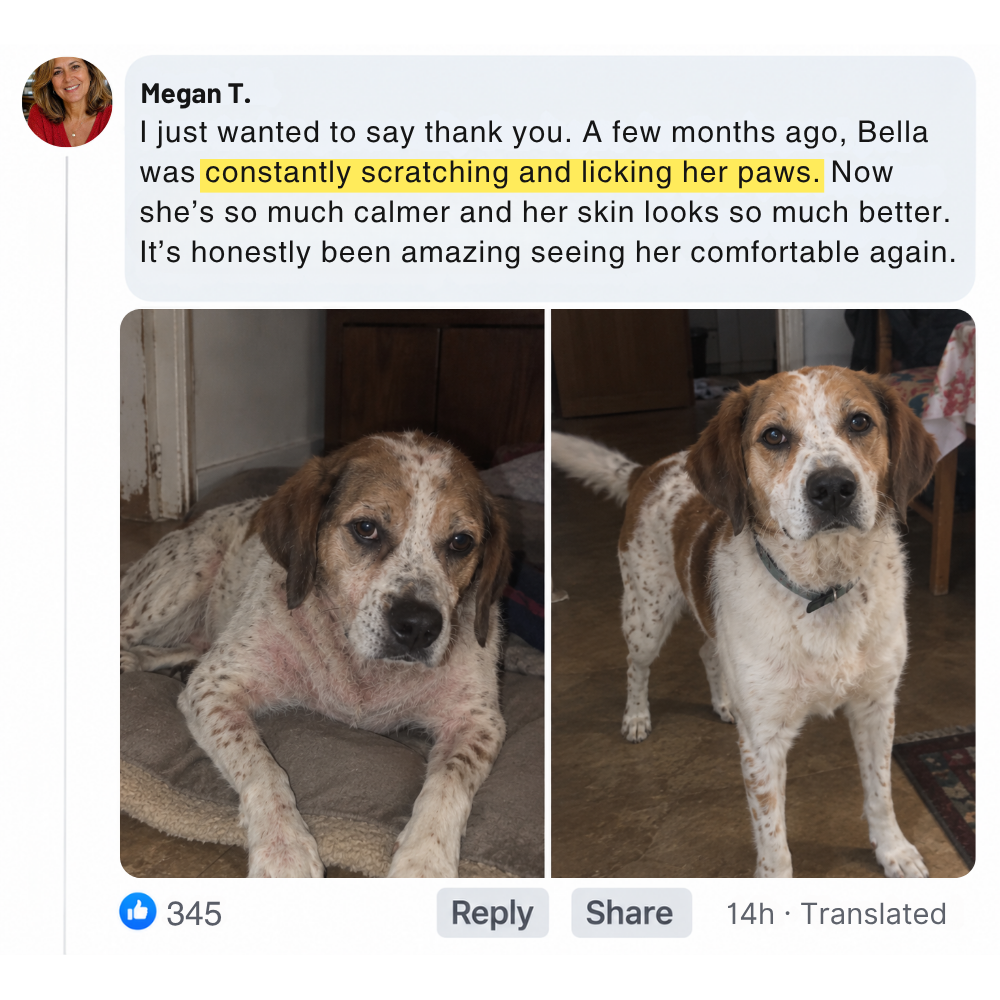
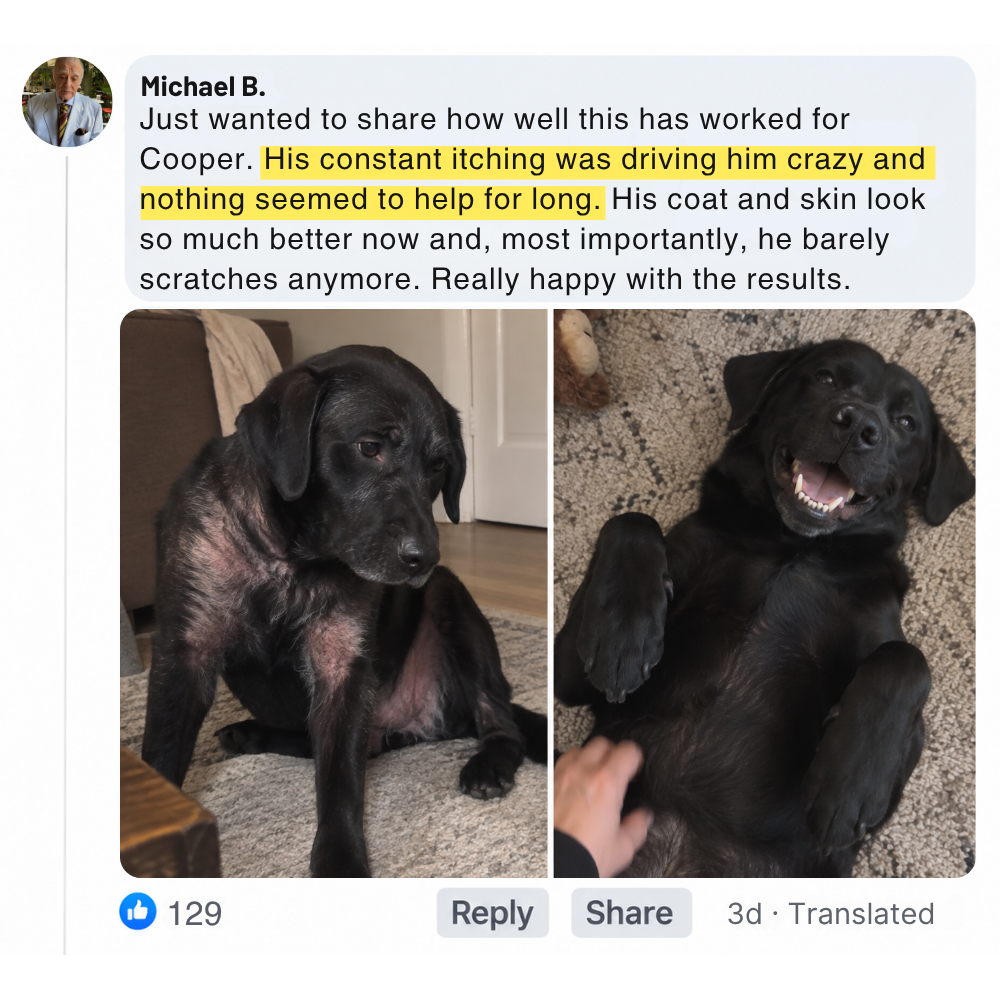
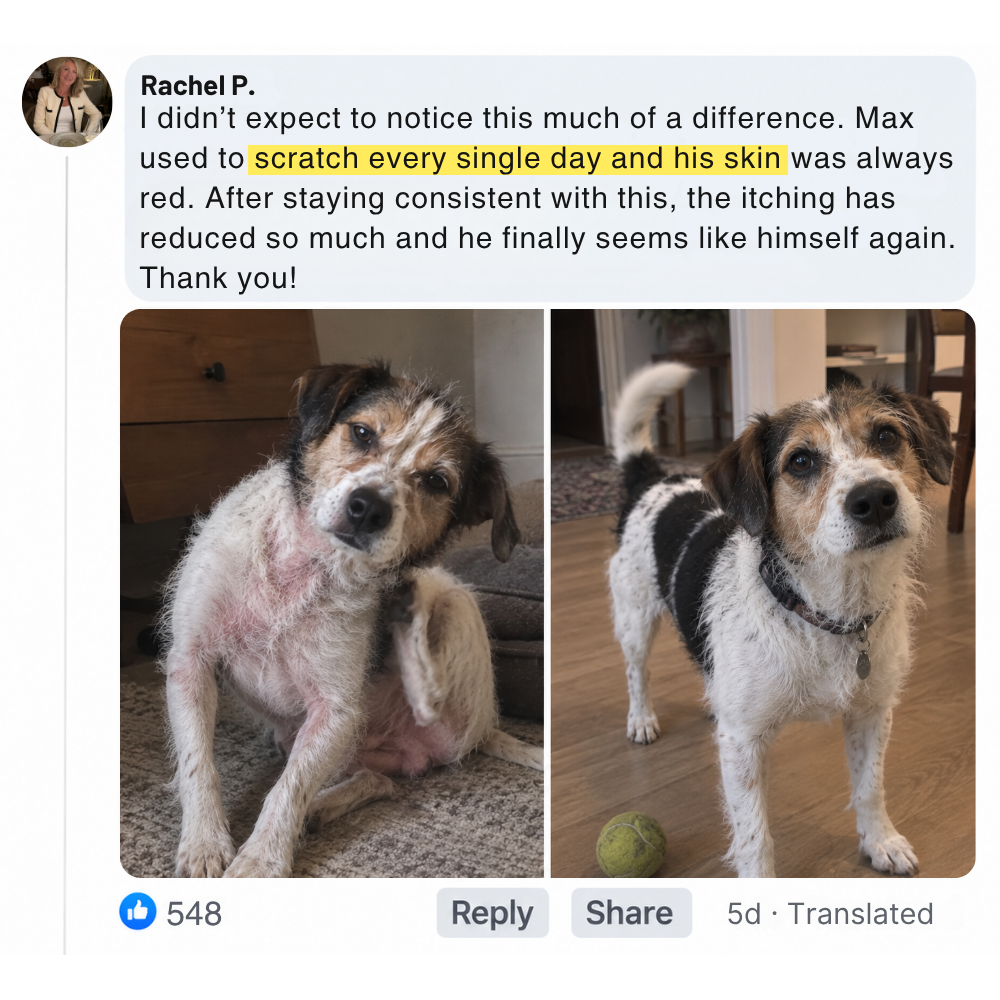
If you recognize your own hopes in those words, that makes sense. A comfortable dog is not an abstract benefit when you are the person sharing the house with them.
But let a review give you a sense of someone's experience, not a diagnosis or a deadline. Your dog's situation may be different. The rest of their care may be different too.
The strongest decision combines the story you relate to with the details you can actually check.
Read the current label. Look at the formula. Ask about suitability. Then decide whether this is the daily option you want to explore.
CHECK CURRENT OPTIONS & AVAILABILITY →Before You Spend Another Dollar, Give It a Job
There is a kind of spending that does not feel like shopping.
You do not buy another shampoo because you need more bottles. You buy it because the dog you love was chewing their paw while you were looking at your phone.
You do not order another supplement because you enjoy comparing labels. You order it because doing nothing feels worse than trying something.
That is exactly why clarity matters before the next purchase.
Ask what you want the product to do, how that fits the care plan and what information will help you review the decision.
Do not compare the price of a supplement with the cost of necessary veterinary treatment as though one makes the other unnecessary. They have different roles.
Do compare the purchase options in front of you. Read the serving directions. Understand whether you are choosing a one-time order or a subscription, and what the current terms say.
A clear budget belongs in a thoughtful care plan. So does a clear reason for each product.
It is okay to want something manageable. It is okay to ask about cost. And it is okay to decide against a product if it does not fit the plan you have agreed for your dog.
The Fets Option, Without the Guesswork About the Order
Fets Allergy & Itch Soft Chews are available through TryFets.com in salmon flavor, with weight-range selections on the product page.[13]
Use that page to check the current pricing and available purchase plans. An offer can change, and the details at checkout should be the details you are choosing.
Look at the formula before you order. If your dog has a known sensitivity, is taking medication, is pregnant or nursing, or has a medical condition, ask your veterinarian about the complete product.
If you are in the middle of an elimination diet, pause and ask whether introducing any flavored supplement would interfere with that investigation.
Then make a straightforward choice: is this an appropriate supplement for the routine you are building?
You do not need a countdown to answer that. You need clear information.
The next page gives you the product options. The decision should still be yours.
Read the Return Terms Before You Need Them
When you have already tried several things, it is natural to want reassurance about another order.
The most useful reassurance is specific.
The current Fets refund policy provides a 30-day window from delivery to request an eligible return. Its standard return conditions include an unused item, in original packaging, sealed and unopened. Opened or used items are not eligible under those standard terms.[15]
That is different from a promise that you can use the chews for a month and automatically get your money back if your dog still scratches.
If you are uncertain, contact Fets before ordering and ask for clarification. If an item arrives damaged, defective or incorrect, the policy provides instructions for contacting the team.
Know the terms before opening the jar. A clear policy is useful only if you understand what it covers.
You can read the current policy directly, rather than rely on a shortened label or an interpretation in a review.
Read the full Fets return & refund policy →
Two Ways the Next Few Weeks Can Feel
There is the familiar version.
You see your dog licking. Search again. Find a new explanation that sounds convincing. Add a product. Change another thing at the same time. Hope you can tell whether it helps.
A few days later, you are back at the beginning, trying to remember which change came first.
Then there is a more deliberate version.
You write down the pattern. Bring the labels. Ask what needs investigating and what the current plan is meant to address. Choose a daily supplement only if it fits that plan.
You know what you are watching. You know when to review it. You know whom to ask if something changes.
Neither version guarantees a perfect outcome. But one gives you a clearer way to make the next decision.
That is the kind of confidence a dog parent deserves: understanding, not pressure.
You can care deeply without chasing every suggestion. You can be hopeful without asking one product to do every job.
And if Fets is an appropriate part of the routine, you can give it in a familiar moment instead of treating the jar as another unanswered question on the kitchen counter.
Here Is Exactly What to Do Next
Step 1: Review your dog's pattern. If itching is persistent, disrupting sleep or accompanied by skin changes, arrange veterinary advice. Do not wait for a supplement to answer a question it cannot diagnose.
Step 2: Review the whole formula. Open the Fets product page and check the current ingredients, weight-range options and feeding information.
Step 3: Ask about suitability where it matters. Mention medication, existing supplements, known food sensitivities and any diagnostic diet trial.
Step 4: Choose the order you actually want. Review the current price, shipping information, subscription conditions if selected, and return policy before checking out.
Step 5: Follow the current label when it arrives. Store the jar safely, use the appropriate directions and keep the rest of the agreed care plan in place.
Step 6: Notice the real-life details. Keep a few simple observations and review them at the agreed time. Contact your veterinarian sooner if symptoms worsen.
This is not the most dramatic ending to an article about itching.
But it is a practical one. And practical is welcome when you have already spent enough evenings feeling that you ought to know what to try next.
EXPLORE FETS ALLERGY & ITCH →More Healthy Days. More Happy Days.
That is the thought behind Fets.
Not a dog who never needs help. Not an owner who somehow makes every decision perfectly. More room for the ordinary life you want together.
The walk where you notice the scenery instead of checking a paw every few minutes. The evening when you are both settled in the same room. The small, familiar routines that make a dog part of your family.
Those are hopes, not a guaranteed product result. They are also the reason the details matter so much.
You are not careless because the problem has been hard to understand. You are not failing because one suggestion did not help. You are a person trying to make good decisions for an animal who cannot explain what they feel.
Start with understanding. Build the plan around your dog. Choose the daily products that fit.
If Fets Allergy & Itch Soft Chews are the option you want to explore, the product page is ready when you are.
With care,
The Fets Team
P.S. Before your next appointment, take a short video of the licking or scratching you are worried about. You do not need to capture a dramatic moment. A clear example can help you explain what you see at home.
P.P.S. Keep a photo of the labels from products you are already giving. The complete routine is more useful to discuss than the one jar you remember to bring.
SEE THE CURRENT FETS OPTIONS →A Few Questions You May Still Have
Is every itchy dog allergic?
No. Itching has multiple possible causes, including parasites and infections. Persistent symptoms deserve veterinary assessment.
Can I give Fets during a food-elimination trial?
Ask your veterinarian before introducing any flavored chew, treat or supplement during a diagnostic diet trial.
Does Fets replace prescribed treatment?
No. Fets is a dietary supplement. Keep prescribed care in place unless your veterinarian changes it.
How much should I give?
Use the current package directions for your dog’s weight. Review the selected product option and ask Fets or your vet if anything is unclear.
How soon will I notice a difference?
There is no guaranteed response or timeline. Agree on observations and a review point with your vet, and report worsening signs promptly.
Can I return an opened jar?
The current standard refund policy requires eligible items to be unused, sealed and unopened. Read the full policy or ask Fets before purchasing.
Sources & Editorial Notes
This is a Fets brand editorial. Veterinary sources explain the condition; they do not endorse or test Fets. Ingredient research is not a clinical trial of the finished formula. Narrative scenes and generated images are illustrative, not accounts of named patients.
- Itching (Pruritus) in DogsMerck Veterinary Manual
- Atopic Dermatitis in DogsMerck Veterinary Manual
- Update on the skin barrier, cutaneous microbiome and host defence peptides in canine atopic dermatitisVeterinary Dermatology / PubMed
- Interleukin-31: its role in canine pruritus and naturally occurring canine atopic dermatitisGonzales et al. / Veterinary Dermatology
- Flea Allergy Dermatitis in Dogs and CatsMerck Veterinary Manual
- Allergies in Dogs — food allergy and elimination dietMerck Veterinary Manual
- 2023 Management of Allergic Skin Diseases GuidelinesAmerican Animal Hospital Association
- Dog Allergies: Symptoms, Testing, and TreatmentAmerican Animal Hospital Association
- Impact of canine atopic dermatitis on dogs and their ownersLinek & Favrot / Veterinary Dermatology
- The Role of Diet, Nutrition, and Supplements in Canine Atopic DermatitisEisenschenk / Veterinary Clinics of North America
- Probiotics as an adjunct: systematic review and meta-analysisPacheco et al. / Journal of Veterinary Medical Science
- Current Knowledge on Canine Atopic Dermatitis: Pathogenesis and TreatmentVeterinary Sciences / PMC
- Current product page; ingredient names and purchase optionsFets
- Customer-story images currently published on the product pageFets
- Current refund policyFets
- Supplementation of diets with bovine colostrum influences immune function in dogsSatyaraj et al. / British Journal of Nutrition
- Effect of inhibitors on histamine release from canine mast cellsCanine mast-cell laboratory study / PubMed
- Bioenhancing effects of piperine and curcumin on botanical-compound pharmacokinetics in beaglesBoonyarattanasoonthorn et al. / Scientific Reports
- Zinc in Dog Nutrition, Health and Disease: A ReviewPereira et al. / Animals